
A good brand is a product, service or company that is generally known among the populace. For example, if asked your familiarity with either Pepsi, Big Mac, Apple or Ford, the average citizen would have some knowledge of the company or product and in most cases consumed, owned or used it. The same can be said for colleges. Mention Harvard, Yale, Princeton, Columbia, New York University, Duke, University of Michigan or Stanford, and you will find most people have at least cursory knowledge of these universities. Narrow your survey further by asking college-bound high school students about their understanding of these iconic institutions and their answers would range from “I want to attend” to “I wish I could attend” to “I have no chance of attending.” These universities have extraordinary brands and for very different reasons, but each draws attention from a broad swath of the American high school community looking for exceptional post-secondary options.
In my previous blog, 3781 to 1, I highlighted the numerous colleges and universities that dot the country and ways to narrow your search. In this blog, I want to discuss how to find what I call hidden gems. They are colleges that are either niches or have niche programs that may be perfectly suitable for you, but you are not aware of them because they lack the brand recognition of the Ivy League or large, well-known universities. However, these lesser known schools may be the right fit for you academically and/or socially and provide the atmosphere and support you need to excel in college. The process I am using to identify a few hidden gems is triangulation – using a fixed point as a reference to develop the desired radius from which to search in.
Let’s start the process with New York University, a well-known and highly selective private university in New York City. It will be our nexus. With NYU as the anchor college, go to Google maps and plug it in. Next, zoom in on the college and see what other colleges appear on the map. If any colleges appear, search the names, and you may be surprised at what you find. In this example, within a ten-block radius of NYU, The New School, and Cooper Union are identified. NYU and The New School are situated in the eclectic, vibrant, and cool neighborhood of Greenwich Village, and Cooper Union is in the nearby area of East Village. Washington Square Park is at the center of this iconic area which is easy to reach by public transportation and populated with unique clothing stores, trendy restaurants, and hip coffee shops. The Village vibe is such that being over 50 years old is just as acceptable as being under 30. Judgment is left at the outer markers.
The three colleges are not identical but have some notable similarities as well as some stark differences. They all offer popular majors and some overlap with each other. For example, each has Art as a major, and NYU and Cooper Union also have Engineering majors while The New School and Cooper Union have Architecture programs. They are all private and expensive though each does have generous scholarship and financial assistance. In specific academic fields, the reputation of the programs offered is second to none. The size of each institution ranges from very large to mid-size to very small.
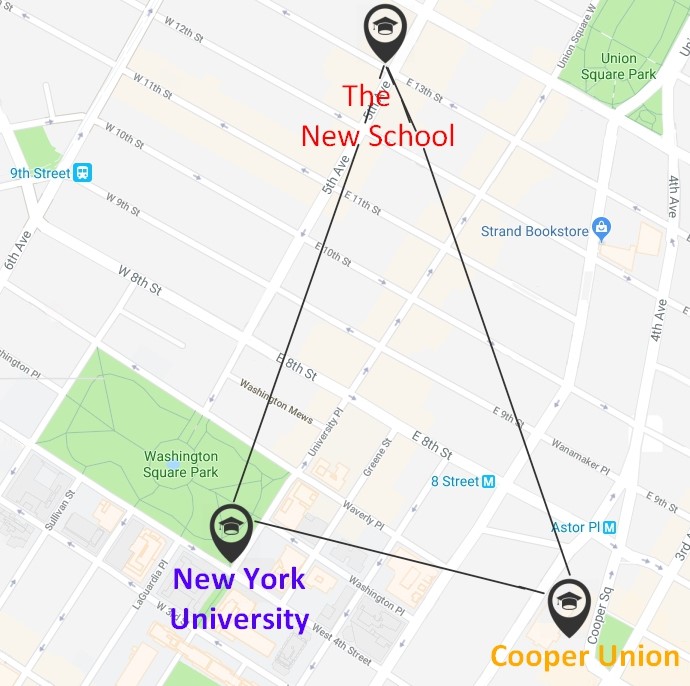
NYU is at the right angle of this triangle and deservedly so. The largest of the group at more than 26,000 undergraduate students, it is a national icon and recognized worldwide as a top-flight university in a host of academic fields including, medicine, business, law, and arts. Google NYU and you will find a long list of alums who are the who’s who on a variety of lists including, famous actors, artists, and captains of industry.
Traveling six blocks north, up 5th Avenue, you reach a unique ensemble of individual colleges merged to form The New School. It is home to Parsons School of Design, one of the best art schools in the country, and the Eugene Lang College, an exceptional liberal arts college where faculty genuinely care about both instruction and research. Undergraduate students registered at The New School is slightly above 7,000.
Five long blocks due east of Washington Square Park is Cooper Union. It is the smallest of the three with a total student enrollment of 964. Don’t let the diminutive size fool you. Cooper Union excels in engineering, art, and architecture and attempts to intermingle the three. This is especially timely today with the addition of art, design, and creativity to STEM which is now STEAM (Science, Technology, Engineering, Art, and Math).
Academically, all three institutions are remarkable and carry tremendous prestige in the domains to which their alums are gainfully employed and excel. The trio offers both research and internship programs to complement your traditional academic experience. Curiously, the student-to-faculty ratio of all three hovers around 9-to1 despite the enrollment of NYU being more than 26 times larger than Cooper Union.
Admission to all three is highly competitive. However, the requirements for admissions are different. The New School is test optional, the other two are not. Engineering applicants to Cooper Union are required to submit answers to additional questions beyond the essay while NYU engineering applicants do not. I could go further, but I think you get the idea.
Are there other regions of the United States where three or more distinct colleges are within close proximity to one another? Yes, large cities offer the most excellent variety of schools contained within a small radius. Boston and the surrounding areas, with a population of 4.8 million people, is a perfect example where approximately 40 institutions can be found. You can easily triangulate between Massachusetts Institute of Technology (MIT), an internationally renowned research institution, Boston University, a highly ranked comprehensive university, and Northeastern University, a premier cooperative education based institution. This ensemble is a brisk 30-minute walk or 10-minute cab ride from each other. Yet a town like Amherst, Massachusetts, with a population of 40,000, also has a rich collection of colleges in and around its city limits including Amherst College, Smith College, and Mount Holyoke College.
Remember the country has 3,781 college and universities, several to be considered in your college selection. I know from many years of experience that more than one university will be a match for you. Summer is upon us, so schedule some college visits and be adventurous!
 yourcollegeselection.com